I’ve heard folks brag about how their latest LLM optimization tool got them ranking on GPT and Claude. And I wonder, is that even possible? What do you mean rank? Do these LLMs organize information in the same manner as Google?
I reserve these questions for the uninitiated, though.
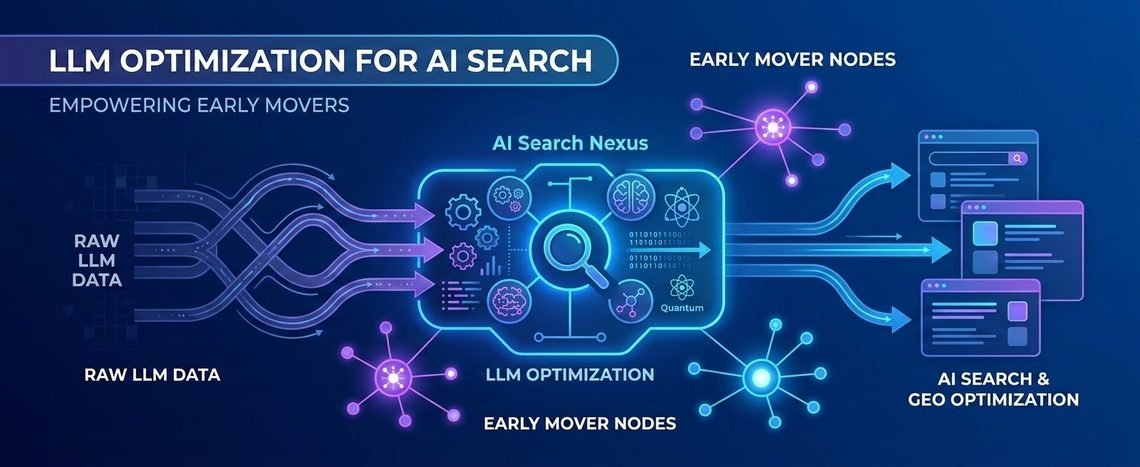
Because those who actually track how AI answers questions about their brand know that the cream of the crop LLM optimization tools can only help:
- Track how often and in what context their brand gets mentioned
- Evaluates the positive or negative sentiments associated with such mentions
- Show the article or documents driving AI’s narrative of your brand
- Suggest changes that can help your brand show up positively, often.
But like with every new-fangled category of software promising to go above and beyond to give you your money’s worth, LLM optimization tools can leave you chasing shadows. I’ve come across a ton of visibility data that swings week to week, because, you know, AI answers keep changing; this got me optimizing for all the wrong metrics, which eventually cost me the gig.
So if you’re an early mover like myself, who is always willing to take the risk of crawling when others are sitting (because, as every nursing mum knows, crawling can attract germs and illnesses) in hope that you’ll someday be among the first to walk, this list is for you.
1. Otterly.AI: for freelancers and solo marketers ready to get their kneecaps hardened

Otterly is an AI visibility tracker you can give a set of prompts to see if your brand is getting mentions from ChatGPT, Gemini, Perplexity, and Microsoft Copilot.
I love the approachable interface and fast onboarding. The pricing is flat, with no credits to calculate, and you get unlimited team members with no sales call.
What I don’t like, though, is that the entry plan covers only 15 prompts, and Gemini and Google AI Mode are paid add-ons. So the $29 upfront is more or less an opening bid, depending on whether the engines you care about are in the base four.
Best for: solo marketer or small-team lead who wants flat pricing, doesn’t need a dozen engines, and would rather learn by doing than sit through a demo.
Price tag: Lite is $29 a month for 15 prompts, Standard is $189 for 100, and Premium is $489. There’s a free trial.
2. Rankscale: for teams who want to see how they perform across multiple chatbots
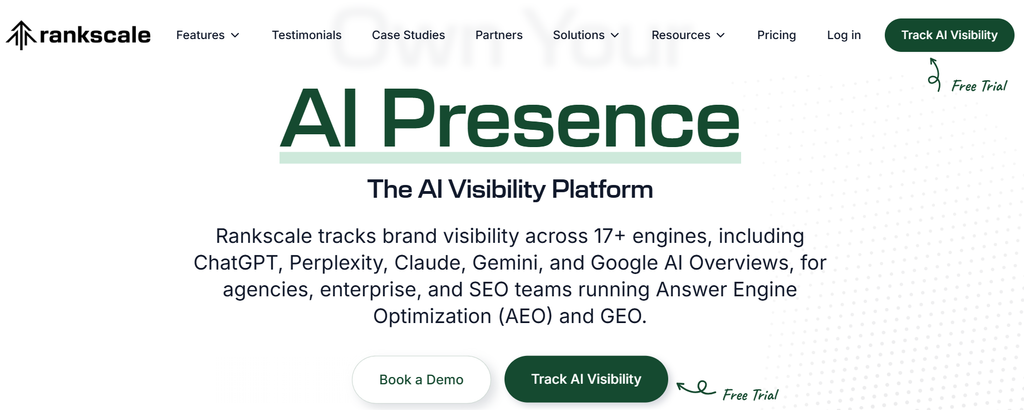
Rankscale tracks brand visibility across 17-plus AI engines, including Mistral, Grok, and DeepSeek. It’s ‘that’ tool (yeah, just like ‘that girl’) with the widest coverage in the category.
Add to that are perks like citation analysis, competitor benchmarks, GEO site audits, and a founder-led team that ships features several times a week.
At such a low entry price ($20), I’d say the breadth Rankscale provides is commendable.
But (and there’s always a ‘but’ with these tools), Rankscale runs on credits, and each engine query costs a fraction of one (reportedly around 0.25 for most engines and 2 for Claude), so real costs are hard to predict. I also noticed that it leans on manual prompt testing rather than automation, and kinda lacks integrated content optimization.
Best for: Teams already running client-facing GEO reporting, not exactly a solo marketer’s first dip.
Price tag: Plans start at $20 a month on credits, and Pro is $99. There’s a 7-day free trial and no free plan.
3. Peec AI: for those who want to track daily trend lines and shifts in brand sentiments
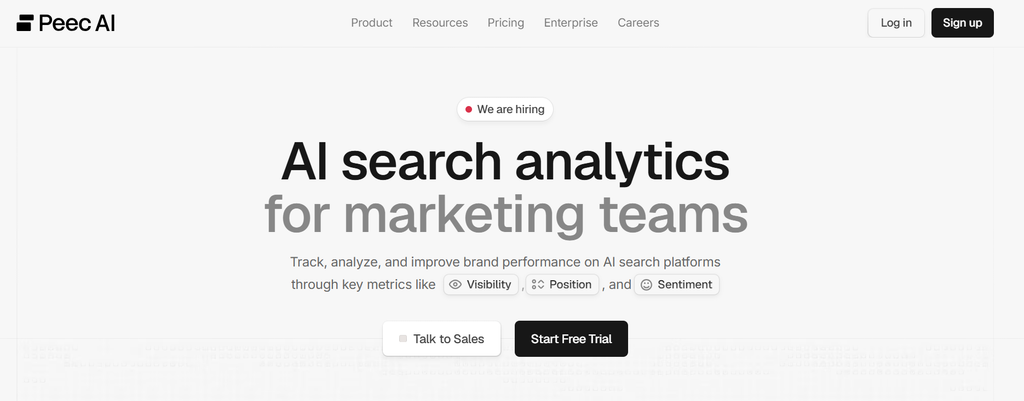
Peec AI is a brand visibility, positioning, and sentiment tracker with regional coverage across 80 locations.
I fancy how it exposes the exact third-party websites, articles, reviews, and listicles that AI platforms cite when shaping answers in your category. But importantly, what I appreciate most is how it doesn’t rely on massive static datasets or monthly updates like most other LLM optimization tools, but instead provides daily updates.
On the downside, each plan covers only three of six engines by default, and a fourth costs extra. And the guided setup proposed 50 prompts with about 40% overlap, which wastes coverage on a 50-prompt plan.
Best for: Marketers who have to prove their worth to their bosses through a tidy, neatly categorized chart.
Price tag: Starter lists around $95 a month for 50 prompts (roughly €70 to €95 depending on source, region and billing), and Pro is around $245 for 150 prompts.
4. AthenaHQ: for turning visibility data and citation gaps into assignable, trackable optimization tasks

AthenaHQ is a GEO platform founded by former Google Search and DeepMind engineers. It tracks your brand across nine-plus AI models, then adds content agents that act on what it finds.
I value its unlimited seats and the hand-holding it provides when showing users where to pitch content or earn placements.
But won’t give it a 5-star rating because the credit meter is opaque. Tracking 11 models daily caps you at roughly 10 prompts, and some of the best features reportedly sit on Enterprise.
Best for: funded founders or in-house teams who want the tool to say what to fix. For a solo freelancer, $295 a month is not a flex.
Price tag: Self-serve starts at $295 a month for 3,600 credits, and the upper end starts at $499 depending on prompts, seats, and engines.
So… which early mover are you?
There’s no silver bullet answer here. None of these tools will tell you how to win in ChatGPT. They tell you where you stand, and you iterate as you go.
But keep in mind that, whichever you try, start with the prompts you’d honestly love to be recommended for, run the free trial hard, and read the credit and prompt limits twice. Don’t cut corners on that part. Stay frosty out there, folks.
👉Open Tech World is a blog for creatives in search of the best tools for their creative process. We won’t say our reviews are unbiased (even though they are), but you’ll have a chill time reading them.