Remember the rush to move from ChatGPT to Claude?…
How people were big on the latter being better than the former because of certain perceived attributes. Yet on paper, both tools—GPT & Claude—had the same features.
Well, that’s because the SaaS market has gotten to a point where feature parity among competing tools is a thing, and adoption and churn rate are not dependent on the feature/benefit debate anymore.
Instead, the spotlight has shifted, and its rays are now oooon … THE USERS.
Or, in more specific terms, their personality type: how they think, how they decide, and how they process the world… but first;
What Are Personality Types?
Personality types are stable or consistent patterns in how people perceive, decide, and act. They help us understand why people pay attention to certain things, how they trust, and what—in this scenario—convinces them to choose an AI tool over another.
To determine how personality types influence software buying decisions, we will lean on the 16-personality model, derived from Carl Jung’s typology and popularized through MBTI.
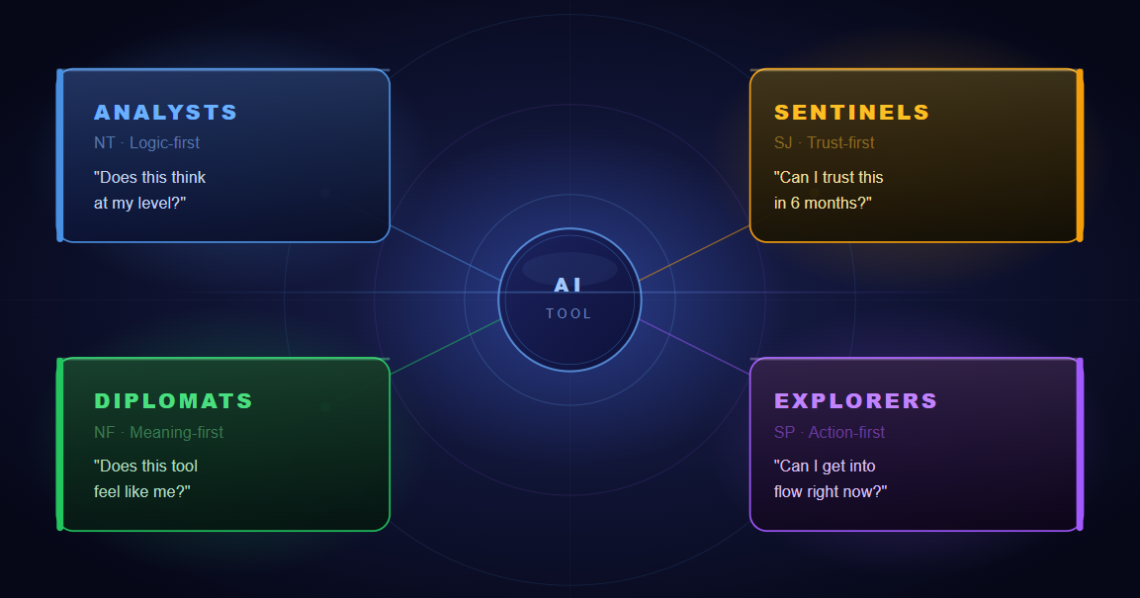
This model groups people into sixteen types, which are nested into four roles:
- Analysts – Architect, Logician, Commander, Debater.
- Diplomats – Advocate, Mediator, Protagonist, Campaigner.
- Sentinels – Logistician, Defender, Executive, Consul.
- And Explorers – Virtuoso, Adventurer, Entrepreneur, Entertainer.
👉 Note that each personality type processes information differently, trusts different signals, and evaluates buying decisions against a different set of criteria. But overall, the four roles in which they are nested provide a bird’s-eye view of how they make decisions; that’s why, to avoid an overly long article, we focused on the roles.
How Personality Types Influence Software Buying Decisions
Every creative person approaches an AI tool asking distinct questions because how their mind understands a tool, what wins their trust, and the internal questions they need answered to drive home a buying decision hold varying levels of importance.
And as a founder (or SaaS marketer), knowing your ideal customer’s personality type helps you answer these questions at an intuitive level. So here goes:
Analysts (NT) – They Choose on Intellectual Respect
Analysts love systems thinking. When they approach things, they strive to spot the underlying pattern and pressure-test it, trusting internal consistency more than they trust enthusiasm.
When someone tells them a tool is “amazing,” their first reaction is to ask, ” Amazing, how exactly?
This shows that they don’t evaluate AI tools the way the marketing team wants them to. They skip the homepage and go straight to the documentation; look at the changelog before they look at the testimonials; and often ignore canned prompts so they can test models on real edge cases from their own work.
These folks are interested in the reasoning chain more than the answer, and are often more focused on questions like: Does this tool think at my level?
Diplomats (NF) – Make Their Choices Based on Meaning
Diplomats are wired for meaning. They read the values beyond the surface clutter of “what does this do?” all the way to “what does this stand for, and does that resonate with who I am?”
People who fall into this category trust authenticity over authority. They prefer a founder who sounds like a real human on a podcast over the same founder’s ghostwritten thought leadership posts.
When these folks evaluate, the first thought that crosses their minds is “Is this tool on brand?” What’s their about page saying, and does their copy sound human? This set of individuals is more concerned about whether your tool’s output feels like THEM.
Whether your AI writing partner (or whichever software you’re selling) gives them something they can actually publish, or something so generic it feels like impersonation. These folks will forgive a clunky interface, but would never forgo grudges held over your sterile tone.
Sentinels (SJ) – Make Decisions off Reliability and Social Proof
Sentinels exist around stewardship. They are all about weighing evidence, precedent, and consequence to ask what’s the responsible move here, and how it looks to the people they are accountable to?
In essence, creatives who fall into this personality type trust track record over hype. A boring tool that’s been around for five years and never had a major outage will earn more trust from them than the indie darling that launched last month.
And this is partly due to the fact that when sentinels evaluate AI tools, what floods the amygdala are the risk factors. These folks don’t mind scrolling past your demo to analyze your security page. They are more concerned about SOC 2, GDPR, audit logs, and data retention policies over your predictable pricing.
So they often ask the questions that the rest of the room often forget to ask: Does this AI tool have a track record I can trust to keep me on track 6 months or a year from now?
Explorers (SP) – Chooses Based on Momentum
Explorers glow from direct experience. Their cognitive instinct is to try the thing and learn through hands rather than reasoning, planning, or reading. They form opinions based on the hands-on experience they had within their first ten minutes of using the tool, rather than what your reviews and onboarding materials say.
In other words, explorers evaluate AI tools by playing with them. When these creatives sign up, they often ignore the onboarding tour. And instead, throw a real task at your tool to see what it gives back.
If they find the first output delightful, they stay hooked. If it’s clunky, slow, or asks to fill in fifteen settings before they can do anything, they move on to the competition. In hindsight, the big question explorers ask is: Can I get into flow with this right now?
How to Optimize Your AI Tools to Address the Needs of All Personality Types
Short answer: you can’t.
Long answer, learn to run ultra-targeted campaigns. The knowledge of personality types and how they influence buying decisions has been in existence for decades, but very few SaaS brands have ever truly capitalized on its vast possibilities.
And that’s because the vast majority of SaaS marketers are relentlessly going on about sales campaigns that hint at touchpoints all customer avatars would find meaningful, when the budget would be better spent on strategies that target specifics ICPs, one at a time.
Finally, on the same note, Open Tech World is a review site that brings its readers (software users) pragmatic reviews of how certain brands fit into their distinct personality types. So if your brand is optimized to address the needs of certain personalities, rest assured that we will spot it and shout off the rooftop about it. However, on the off chance that we don’t, you are free to email us with information about your tool.