Table of Contents
- What is Open Tech World
- General writing tips
- Our target audience & content approach
👉It’s nice to know you’d like to contribute to Open Tech World. This guide is a point of reference to help you create content that works for us. We want our blogs to be clear, crisp, and in line with our brand values.
Please don’t hesitate to ask us any questions or reach out to teamopentechworld@gmail.com if you need further clarification on the sections below. It is best to ask questions first before you start writing.
What is Open Tech World
Open Tech World is a digital hub for people who want to show how specific tech tools have helped make their creative work a little more manageable.
We cover topics where software and the creative life intersect, such as comparisons and reviews, industry surveys, how-to guides, and content regarding all the nitty-gritty details creative folks need to know about when making a software buying decision.
Our content aims to get people thinking about their buying decisions in personalized ways. We believe that artificial intelligence blurred the line between the computing capabilities of software and the imaginary nature of the creative process, and to create a sustainable path forward, we must reinvent the way creatives think about software.
Key things to remember as you read Open Tech World’s Brand Guideline:
- We’re enthusiastic about what we do, and want others to feel just as excited about our work
- Tonally, we aim to be clear, concise, entertaining, and informative
- We like opinions backed up by research
- We’re not opposed to a bit of irreverent humor now and then
- We use emojis (sometimes)
- We don’t always use complete sentences
- We consider content pegged to seasons and trends, but we generally prefer content that will stand the test of time.
- Sometimes we address you, the reader, with rhetorical questions. Does that feel more engaging?
🚨 It’s important to remember that Open Tech World is not a newsroom, so we do have a lot more leeway when it comes to letting your idiosyncrasies shine.
General Writing Tips
Voice and Tone
Our brand voice is how we express ourselves through writing. It’s like our personality. And for one, it’s FEARLESS. Fearlessness is expressed in Open Tech World’s content through bold, direct, and straightforward messaging.
Next up is FOCUSED. Focused, in this instance, is being empathetic or responsive to the audience’s needs. When writing for Open Tech World, your content should be oriented towards educating and entertaining the reader—in that order. Display confidence, authority,
respect, and knowledge.
FOR EVERYONE. Just as every craft has a creative side to it, Open Tech World’s content is meant to be flexible enough to work for everyone.
Writing Principles
- We use short, succinct sentences that get directly to the point.
- We use active rather than passive voice, where it is clear who is responsible for the action.
- We use specific and concrete examples rather than vague, abstract language. However, we try not to overload the reader with too much information. We focus on what they need.
- We strike a conversational tone, as though we’re talking to a friend rather than a faceless crowd.
- We avoid excessive hyperbole. An “awesome” or two is fine. But if everything is awesome, what actually is awesome?
- We encourage using bulleted lists within the content to help break up large chunks of text.
Word Choice
- Any style guide will advise you to avoid jargon, but the difficulty is that jargon is subjective and depends on the audience.
- To avoid using jargon and confusing your audience, be empathetic to your audience’s point of view. Avoid borrowed foreign terms and Latin phrases unless they’re part of the common English language.
- Be thoughtful about using words like “simple” or “effortless.” What’s effortless to one person might not be so easy for another.
- We don’t necessarily have to avoid the word “master,” but it’s good to know that several prominent tech companies (including GitHub) have publicly announced that they are avoiding it.
- Write out abbreviations if you’re using them for the first time, unless they’re commonly used.
- In general, avoid too many synonyms on the same page.
Grammer
We use American English, but we avoid Americanisms and other culturally-specific references that might not be familiar to non-Americans. This is subjective, and there’s no right or wrong answer. But be aware.
We use the metric system of measurement (meters, kilograms, Celsius), rather than the US or imperial system (yards, pounds, Fahrenheit). You can make exceptions for idiomatic phrases or specific references, such as if you’re going to walk 500 miles.
You can use the past or future tense. We’ve found that simpler is better, but not always the right answer.
However, the tense should always be consistent within a single page, article, or section. Similarly, it is best if the tense remains consistent within a single type or category of content. For example, if you’re creating a series of articles or guides featuring interviews, it’s best if all of the interviews are written in one tense, whether that’s the future, present, or past tense.
Punctuation
Beware of comma splices. A comma splice is a punctuation error where you join two complete sentences with a comma. This is a comma splice: ❌ Comma splices are common, a lot of people splice sentences together with commas.
To fix a comma splice, just split the sentence in two with a period, or use a colon if you feel like the sentences are closely connected. ✔ Comma splices are common; a lot of people splice sentences together with commas.
- We have a thing for the serial comma (otherwise known as the Oxford comma).
- Use UPPERCASE or bold the text when you need to make a point glaringly obvious.
- Default to sentence case, or sentence-style capitalization, for website headings, subheadings, and CTAs. Also, capitalize the first letter of all listed Product features—it makes it easy for the reader to know we are referring to a name.
- For body text, write out numbers in English from zero to nine. For numbers 10 and above, use Arabic numerals (56, 355, 12).
- For dates, use the 12-hour clock for readability, with a.m. and p.m.—always lowercase.
- Use a hyphen (-), not an en dash (–), to indicate a range between numbers or dates. (I explored both tools from September 12-19).
- The Em-dash (—) to a lot of content folks signals AI, but not to us. Yet, we will advise you to use it sparingly.
Try to run your text on Grammarly to catch any punctuation errors you might have missed. But please don’t take all their suggestions at face value because while we have this style guide to help direct your voice, we still want content that’s authentically you.
Perspective
We are totally fine with first person, second person, and third person. Find the perspective that best fits your post. Other than that, the most important thing to remember about perspective is consistency.
We think it’s jarring if we start a page in first person singular, and then I suddenly jump in and start talking from my own perspective.
That aside, some brands have multiple software products under their banner. It’s important to keep our pronouns consistent so that it’s easy to tell whether we’re talking about a product or the company behind the product.
Citing Research
A citable research is a scientific study published in a “reputable” journal by accredited researchers. It is not a group of friends with an idea, nor an internal analysis from a corporation.
For example, if a company conducts a review of its internal communications practices, this is not a “citable research.” If you’re uncertain, go back to the source to see how the originators of the so-called research described it.
If Gallup publishes a survey and calls it a survey, don’t change it to “study.” The study doesn’t have to be peer-reviewed, but it also can’t be hosted on blogspot dot com.
For Hyperlinks, the anchor text or link label should describe the content that is linked to. Not only does this just make sense, but it’s also good practice for SEO.
Open Tech World’s Brand Guideline also requires that when you’re citing a second-hand source (let’s say quoting someone who was initially quoted in another article in another publication), make it clear. For example, if Apple quotes Elon Musk as saying “iPhones are the best,” don’t directly quote Elon Musk in your post. Attribute the quote to both Apple and Elon Musk.
Images
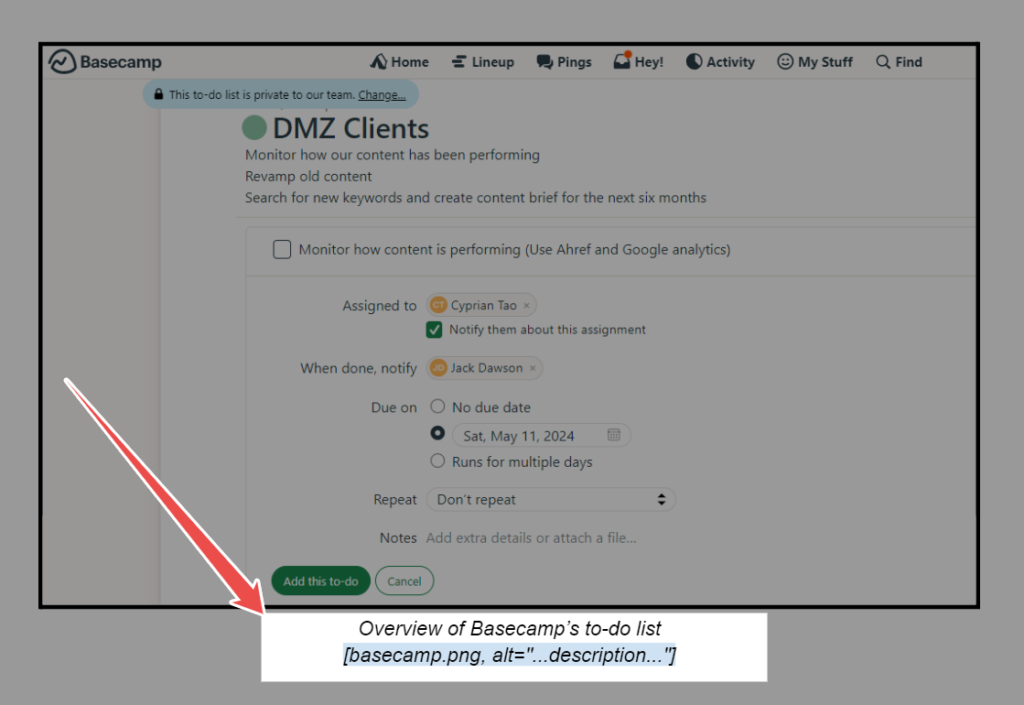
Try to back your piece with multiple screenshots showing that you actually used and tested the tool. If you’re reviewing an enterprise software and are unable to test the tool, please consult their product guide for suitable screenshots.
We advise you to use Annotely to make your screenshots descriptive.
Also, when annotating images, use Red. But this is not written in stone; if you find a more suitable color in line with the UI of the software you’re reviewing, fire away. Just keep color consistent across the article.
Don’t forget to add image name and alt-text to images; suitable for the disabled and also good SEO practise. Eg:
SEO/AEO Activities
At the top of your article, add a table structured like this:
| Main Keyword: | Open tech world’s brand guideline |
| Meta Title: | Must Read if You Want to be Featured on Open Tech World |
| Article Title: | Open Tech World’s Brand Guidelines & Writing Style Guide |
| Meta Description: | Open Tech World’s brand guideline is your guide to getting a byline on a digital hub where creatives show how software aids the creative process. |
| URL slug: | /open-tech-world’s-brand-guideline |
Use the Meta Length checker to ensure your Meta description and title length don’t exceed the character limit.
Ensure you start your Meta Dec with the main keyword of your chosen topic.
If you have a DashWord or SurferSEO subscription, optimize for natural language. But not to worry if you don’t have it, we will handle that from our end.
If you understand schema code, provide one. Otherwise, don’t worry, we will also handle that side of things.
Add disclaimers at the top of your content if affiliate links are included. Saying it upfront is not a direct SEO win, but it helps build trust with readers.
👉Overall, we aim for content that’s straightforward to read. Replace super-long sentences with short, concise paragraphs that get directly to the point. But don’t compromise clarity for brevity. If an idea requires a long sentence to make it stick, please flow away.
We aim for content on the bold/creative side when compared to most review blogs. We also strive to be very conversational. But the flow and formatting must be your top priority. Don’t outdo yourself trying to be too funny or “edgy”. The primary goal here is to provide value.
In essence, write as if you’re talking to your creative self. Kindly read through our blogs for a preview of what we expect.
Our target audience & content approach
We Exist for Creative Folks Who…
Understand that while their creativity is reliant on the imaginative fortitude of their muse, multiple software tools exist to help put the repeatable processes of the work they do on the back burner so they can focus on the creative clatter needed to pursue original ideas.
These folks are engaged in knowledge work, rather than manual labor.
Examples include programmers, architects, engineers, marketers, software engineers, graphic designers, lawyers, editors, writers, solo entrepreneurs, project managers, CEOs, etc.
Our Content Approach (Personality-Oriented Content)
At Open Tech World, all our content follows a certain framework. They all have a personalized element to them. This is to ensure that we’re focusing on building trust with our readers, rather than chasing organic traffic.
For clarity, PERSONALIZED content is any type of content that strategically weaves a creative personality into the narrative and uses it to illustrate a point, solve a problem, and/or help the reader understand why a software might be or not be a good fit for the work they do.
In a personality-oriented content piece, the angle is in some way connected to the personality of the reader. The software is entwined with how certain creatives think and presented as the go-to solution or absurd solution (with annotated screenshots) for specific readers.
The best-case scenario involves merging appropriate personality types to the value of a solution, so that the reader can find their habits in our words and becomes confident that we have their best interest in mind, and ain’t out here advertising quack tech tools.
👉 Overall, Open tech world’s brand guideline exists to show you how we answer our readers’ question and show them that our reviews go deeper than features and benefits, all te way to how they think and approach work. So kindly write accordingly.
Look forward to reading your piece. Cheers!