
I use AI every day for research, but it has never written a single sentence of my actual work.
That boundary matters.
Using AI for research saves me hours when I’m trying to understand unfamiliar technical concepts, but the moment I start writing, the AI stops being useful.
Personally, I’ve found that AI excels at helping me get oriented quickly, but it fails completely at synthesis, judgment, and the kind of clear explanation that comes from actually understanding something.
This isn’t about which tools to use. It’s about knowing exactly where AI helps and where it starts to hurt the quality of your work.
Why I Use AI for Research?
Research takes time, and when you’re working on technical topics outside your core expertise, the early stages can feel overwhelming. Starting from zero with a complex system or an unfamiliar concept means wading through documentation that assumes knowledge you don’t yet have.
AI cuts through that initial confusion faster than anything else I’ve tried.
The cognitive cost of research isn’t just about time.
It’s about the mental energy spent translating dense technical language, piecing together how different components relate to one another, and building enough context to ask good questions.
AI helps with all of that.
It doesn’t replace deep investigation, but it makes the early exploration phase less exhausting and more productive.
Speed during research doesn’t compromise depth later. In fact, getting oriented quickly means I can spend more time on the parts that actually matter: understanding trade-offs, testing assumptions, and developing informed opinions about the topic.
How AI Fits Into My Research Workflow
AI enters my workflow at the beginning, during the exploration phase, and exits before I start synthesizing information or writing anything. That’s the boundary that keeps my work original and grounded in real understanding.
I don’t use AI research tools for their specific features or capabilities. The tool matters less than understanding what kind of output is actually useful.
What I need from AI during research is context, terminology, and structure. I need to understand how experts discuss a topic, identify the key components of a system, and focus my attention as I dig deeper.
Having boundaries matters more than choosing the right AI tool. Once you know that AI should never touch your synthesis or writing, the specifics of which model or interface you use become much less important.
The workflow stays the same regardless of the tool.
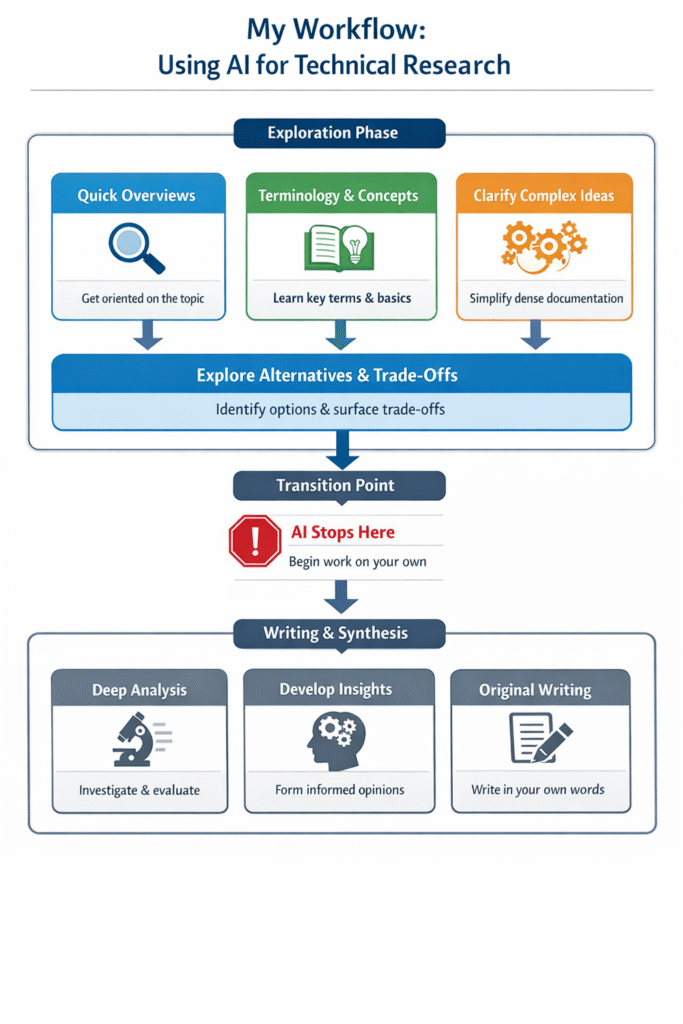
Using AI During Early-Stage Content Research
When I’m starting research on a topic I know little about, AI helps me get my bearings. I’ll ask for a high-level overview of a system, technology, or concept just to understand what I’m looking at before I start reading documentation or technical papers.
Terminology discovery is one of the most practical uses of AI in technical research.
If I’m reading about a system and encounter unfamiliar terms or acronyms, I can get quick definitions without breaking my focus. This is especially useful when documentation assumes prior knowledge and doesn’t bother explaining foundational concepts.
The goal at this stage isn’t to understand everything deeply. It’s to build enough context that I can ask better questions and know where to look next. AI helps me move from complete unfamiliarity to productive investigation faster than I could on my own.
Using AI to Clarify Complex Technical Ideas
Some technical systems are genuinely difficult to understand from documentation alone. The writing might be accurate but dense, or it might assume you already understand related concepts. AI can simplify these explanations without sacrificing the essential technical details.
I use AI to translate dense documentation into clearer language, especially when I’m dealing with architectures or workflows that involve multiple moving parts. Instead of re-reading the same paragraph five times, I can get a plain-language explanation that highlights the key components and relationships.
This isn’t about dumbing down technical content. It’s about getting a foothold in unfamiliar territory so I can engage with the real documentation more effectively. Once I understand a system’s structure, reading the official docs becomes much easier.
Using AI to Explore Alternatives and Trade-Offs
AI is useful for surfacing alternatives I might not have considered. When I’m researching approaches to a problem or comparing different technologies, AI can quickly map out different options and highlight trade-offs worth investigating.
This doesn’t mean I trust AI to make decisions or draw conclusions.
It means I use AI to identify what needs deeper validation. Surfacing options is different from recommending solutions. AI helps me see the full environment, but I still have to evaluate each option based on my specific context and requirements.
Where AI Stops Being Useful
AI-generated summaries are almost always too shallow to be useful beyond the initial orientation phase. They lack nuance, skip over important edge cases, and often miss the exact details that matter most in technical work. I don’t trust AI to summarize documentation or articles accurately enough to skip reading the original source.
Judgment and synthesis cannot be automated.
AI doesn’t know what’s important for my specific use case, what trade-offs matter most in my context, or how different pieces of information relate to the broader problem I’m trying to solve. Those decisions require understanding that comes from actually engaging with the material, not from pattern-matching in a language model.
Trusting AI output beyond research creates real risk in technical writing. If I let AI generate explanations or summaries that I don’t fully understand myself, I end up publishing work I can’t defend or explain.
That’s not acceptable for any technical content where accuracy and credibility matter.
Where I Transition From Research to Writing
The transition from research to writing is where my actual work begins. Once I’ve gathered enough information and built enough understanding, I close the AI interface and start writing from my notes and my own comprehension of the topic.
Writing from understanding rather than from AI output changes everything about the final product. The structure comes from how I’ve organized the information in my mind, not from how an AI might arrange it. The framing reflects my perspective and priorities, not generic explanations optimized for broad applicability.
Personal synthesis produces better structure and framing because it’s grounded in real engagement with the material. I know which details matter, which trade-offs are most significant, and how to explain concepts in a way that actually helps readers understand rather than just presenting information.
What This Approach Changes About My Writing
Using AI strategically for research has made my writing clearer and more confident. Better-informed research means I can structure explanations more effectively and anticipate questions readers might have. I’m not guessing at technical details or hedging my language to cover uncertainty.
My technical explanations are stronger because they’re based on actual understanding, not paraphrased AI output. I can explain not just what something is, but why it works that way, what the alternatives are, and where the trade-offs lie. That depth only comes from doing the real work of synthesis myself.
The content stays original and opinionated because AI never touches the writing itself. My voice, my perspective, and my judgment shape the final product. AI helped me get there faster, but the work is mine.
Conclusion
AI accelerates research without replacing the thinking, structure, or writing that makes technical content valuable. It’s a support layer that saves time during exploration and comprehension, but it stops being useful the moment you need judgment, synthesis, or original explanation.
Authorship and responsibility stay with the writer. That’s not a limitation. It’s what makes the work credible, useful, and worth reading. Using AI for research produces stronger content precisely because it frees up time and mental energy for the parts that actually require human expertise.
Frequently Asked Questions
- Is it okay to use AI for research?
Yes, using AI for research is completely acceptable as long as you maintain clear boundaries. AI excels at helping you understand unfamiliar concepts quickly, discover terminology, and explore different approaches to technical problems.
- How do people use AI for research?
Most people use AI for research in three main ways: initial topic orientation, terminology discovery, and exploring alternatives. People also use AI to quickly understand acronyms and technical terms without breaking their research flow.
- Can AI help with technical research?
AI can significantly help with technical research, particularly when you’re starting from limited knowledge. Use AI to build an initial understanding, then validate everything through proper documentation and testing.

